- The Money Maniac
- Posts
- 💰 This Isn’t The 1970s
💰 This Isn’t The 1970s
Inflation is rising and the labor market is cooling, but Fed Chair Powell insists this is not stagflation.

Daniel Anderson
March 20, 2026
Sponsored by

Good morning, Maniacs!
Inflation is heating up, hiring is slowing down, and oil prices are finding a home in the $95 range.
That mix has markets on edge… and the comparisons are getting uncomfortable.
But Powell isn’t buying the stagflation narrative.
Today, we’re unpacking why this is not the 1970s, what the Fed is actually worried about, and where things could still go wrong.
Plus: a 520% IPO pop, nuclear energy’s comeback, tariff refunds on the way, and the oil price that would actually trigger a recession.
Let’s dive in! 👇
OUR PARTNER: FISHER INVESTMENTS
Are You Ready to Actually Retire?

Knowing when to retire is harder than knowing how much to save. The timing depends on what your retirement actually looks like: how long your money needs to last, what you'll spend, and where your income comes from.
When to Retire: A Quick and Easy Planning Guide is built for investors with $1,000,000 or more who are ready to move from saving to planning. Download your free guide and start working through the details.
THE MAIN EVENT
This Isn’t The 1970s 🕰️
The Fed held interest rates steady this week. That part was expected.
The real story is how Federal Reserve Chair Jerome Powell framed it and what that says about where policy is heading.
Inflation is heating up again, GDP growth came in weaker than expected, and now an oil shock is adding fuel to the fire. That mix has started to spook investors and bring back the “S-word.”
Powell isn’t buying it.
Why The Fed Is Standing Still
The Fed is dealing with a tricky mix right now:
1) Inflation is ticking up
The latest inflation reading pushed core PCE to 3.1%, a noticeable jump that caught markets off guard.
Producer prices (PPI) came in hot as well. These track what businesses pay for goods and materials, and often point to where consumer prices are headed next.
Energy is now adding to the pressure. Gas prices have surged 25% in just three weeks due to the Iran conflict, and much of that hasn’t shown up in the official data yet.
Put it all together, and inflation isn’t just elevated — it’s starting to reaccelerate.
2) The labor market is cooling
The economy shed roughly 92,000 jobs in February. Unemployment remains low, but hiring has slowed meaningfully.
Powell described this as a “zero employment growth equilibrium.” In plain English: stable, but not growing.
That’s not a crisis, but it shifts risks to the downside. If hiring weakens further while inflation rises, the Fed gets pulled in two directions with no easy answer.
Powell’s Case Against Stagflation
Even with that setup, Powell made it clear he does not see a 1970s-style stagflation scenario.
It’s an important distinction, because stagflation isn’t just “things feel bad.” It’s a very specific mix of high inflation and a non-growing or contracting economy.
Here’s why he pushed back:
1) Growth is still positive
The Fed actually raised its GDP forecast to 2.4%. That may not be booming, but it’s far from stagnation.
2) Unemployment is still low
At 4.4%, the labor market is cooling, not breaking.
In true stagflation periods, unemployment spikes dramatically. It peaked at 9% in the mid-1970s, which is a very different environment from what we’re seeing today.
That said, this is the piece worth watching. Labor markets can deteriorate quickly once momentum turns.
3) This is a supply shock, not a broken economy
Powell attributes most of the current inflation to external forces, not internal excess.
Tariffs, for example, act more like a one-time price reset than an ongoing inflation cycle. That’s very different from demand-driven inflation, where spending keeps pushing prices higher.
Where The Fed Loses Visibility
Confidence fades when the conversation turns to energy.
Tariffs can be modeled. Policy can be forecasted. A geopolitical conflict cannot.
The key question: is this a short-term spike, or something more persistent?
“Nobody knows… the effects could be much bigger or much smaller.”
That uncertainty didn’t lead the Fed to panic. It pushed them to lean more hawkish, meaning more focused on fighting inflation.
Inflation expectations were revised higher, with core PCE now projected to end the year at 2.7%, up from 2.4%
Rate expectations shifted toward fewer cuts, with 7 of 19 officials now expecting no cuts this year
The longer-run policy rate moved up to 3.1% from 2.5%
The message is subtle but important: The Fed is more concerned about inflation than unemployment.
The New Rate Reality
This shift matters more than it seems.
For years, markets believed 2.5% interest rates were “normal.” The Fed is now signaling that “normal” may be 3% or higher, which quietly resets the entire playing field.
All else equal, a higher baseline rate tends to pressure:
Bond prices
Rate-sensitive sectors like real estate and utilities
Small caps with floating-rate debt
At the same time, it benefits or protects:
Big tech and financials, which earn more on cash and short-term assets
Companies with strong balance sheets and low financing needs
And it raises the bar for risk-taking:
Startups and speculative investments face more expensive capital
Gold and Bitcoin lose some appeal as non-yielding assets
The Bottom Line
Of course, none of this is set in stone. Powell’s entire outlook depends on inputs that are still moving.
What the Fed is giving you here is not a fixed outcome. It is a baseline scenario that markets are starting to price in.
If your view on inflation, growth, or rates differs, that’s where the opportunity lies.
MARKET MOOD
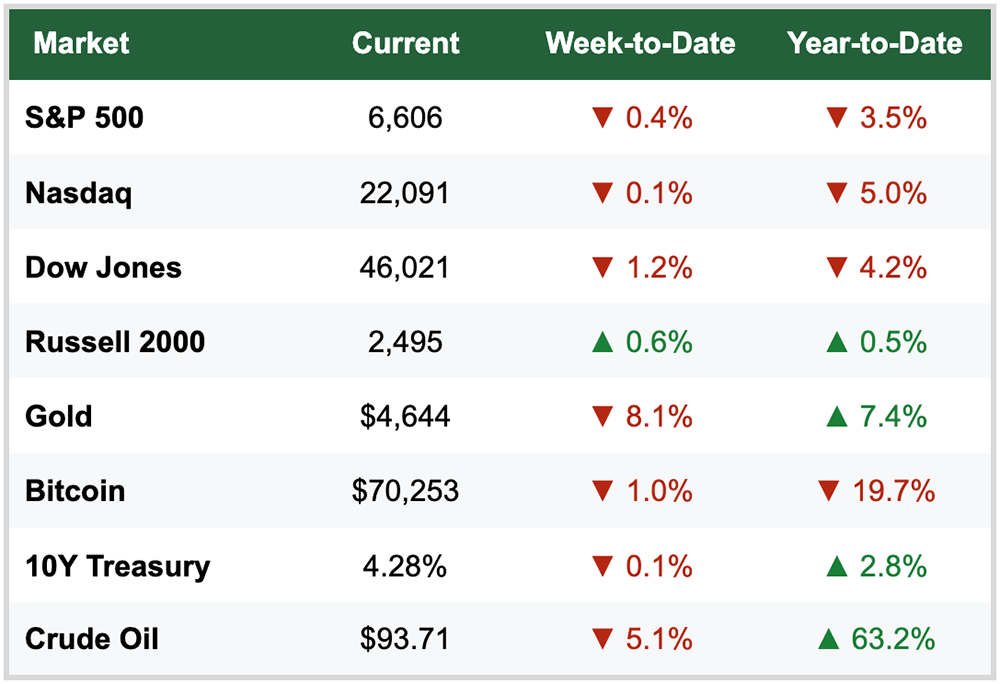
The Picks And Shovels Keep Winning ⛏️
Winners
Ciena ($CIEN) - Market Cap: $58.3B (Week-to-Date: +22.3%)
Ciena jumped as investors started treating it like a core AI infrastructure play. The company builds high-speed fiber and networking gear that connects data centers, and demand is exploding alongside AI buildouts. At this week’s OFC conference, Ciena showcased new AI-ready networking tech, reinforcing why analysts see it as a “hidden” winner.
Delta Air Lines ($DAL) - Market Cap: $42.5B (Week-to-Date: +10.6%)
Delta rallied after raising revenue guidance at a JPMorgan conference, easing fears that higher fuel costs would crush margins. Management pointed to strong demand, especially from higher-end travelers, with bookings running well ahead of last year. And it wasn’t just Delta: American and JetBlue also bumped their sales outlooks.
Micron ($MU) - Market Cap: $500.0B (Week-to-Date: +4.3%)
Micron crushed earnings and raised guidance as AI demand continues to soak up memory supply. Data center sales surged, pricing improved, and the outlook came in way above expectations. Still, after a 300%+ run over the past year, the stock only moved modestly — a sign that a lot of the good news was already priced in.
Losers
The Trade Desk ($TTD) – Market Cap: $11.2B (Week-to-Date: -14.0%)
The Trade Desk sold off after Publicis, one of the world’s largest ad agencies, flagged issues with “improper fee layering” and auto-enrollment practices on the platform. That’s a tough hit for a platform built on advertiser trust. The stock is now down 58% over the past year, and even rumors of a potential OpenAI partnership weren’t enough to stop the slide.
Newmont ($NEM) – Market Cap: $107.9B (Week-to-Date: -9.5%)
Newmont is the world’s largest gold mining company, and gold got hammered this week. Higher oil prices drove inflation fears up, rate cut expectations further out, and Treasury yields even higher. When bonds start paying more, gold loses its edge — and miners like Newmont feel it fast.
OUR PARTNER: TABS
AI Alone Can’t Run Revenue
Finance doesn’t run on “mostly right.” It runs on math.
In The Architecture Behind AI-Native Revenue Automation, Tabs’s CTO breaks down why LLMs alone aren’t enough—and what it actually takes to build audit-ready, AI-driven contract-to-cash systems for modern B2B teams.
CHART OF THE WEEK
Do You Own the Market, Or The Leaders? 👑

The S&P 500 is increasingly “top-heavy.”
The 10 biggest companies now account for 39% of the index, and the Magnificent 7 alone are 33%.
Top 10 weights:
Nvidia: 7.3%
Google: 6.2%
Apple: 6.1%
Microsoft: 4.8%
Amazon: 3.8%
Meta: 2.6%
Broadcom: 2.5%
Tesla: 2.4%
Berkshire Hathaway: 1.7%
Eli Lilly: 1.4%
That concentration has been great for returns.
The S&P 500 is up about 70% over five years, but the Mag 7 returned roughly double that. Without them, the other 493 still did fine, but closer to an 8% annual pace vs 11%.
The trade-off is simple: more upside potential, but less diversification.
If you’re truly focused on preserving wealth, you may want to consider a total market index or an equal-weight S&P 500 approach.
FAST FACTS
From 520% IPOs To $100B Bets 🚀
🚀 This IPO Went Absolutely Parabolic: AI drone software firm Swarmer jumped 520% on day one… despite less than $310K in annual revenue. [Read]
💸 Tariff Refunds Are (Finally) Coming: The U.S. government is building a system to refund companies for improperly collected tariffs. A new portal could launch within 45 days, with billions on the line. [Read]
🧠 Nvidia Is Shifting Its Playbook: The AI king is moving beyond training models to powering them in real-time (“inferencing”) and launching AI agents. [Read]
☢️ Nuclear Energy Is Back In Focus: Oklo is advancing its first small nuclear reactor with U.S. government backing. Big Tech is already lining up for reliable power to fuel AI data centers. [Read]
🛢️ Recession Risk Has One Big Trigger… Oil: Economists say a recession won’t hit unless oil spikes to $138 and stays there. Right now? We’re closer to $94. [Read]
🧾 What To Do If You Get Audited: Only ~0.2% of returns were audited last year, but if you’re selected, you’ll be notified by mail. Then, it’s all about responding on time and having your records ready. [Read]
🤖 Bezos Plans the AI Factory of the Future: Jeff Bezos is reportedly raising a $100B fund to buy industrial companies and supercharge them with AI. Think robots, chips, and automation on steroids. [Read]
WORDS TO REMEMBER
Your Ego Is Costing You Money 🧠

Thanks For Reading!
How was today's email? |
Spread The Wealth 💸
Like what you read? Do me a favor and don’t keep it a secret! Send this newsletter to a friend and help them level up their financial game—one fact at a time.
Click the button above -or- copy and paste this link: https://read.themoneymaniac.com/subscribe?ref=PLACEHOLDER
DISCLAIMER: The information provided in this newsletter is for informational purposes only and should not be construed as financial advice or a solicitation to buy or sell any assets. All opinions expressed are those of the author and are subject to change without notice. Please do your own research or consult with a licensed professional before making any investment decisions.
MENTIONS: $CIEN ( ▲ 0.36% ) $DAL ( ▼ 1.41% ) $MU ( ▲ 2.81% ) $TTD ( ▲ 4.91% ) $NEM ( ▼ 2.08% )
Reply